


DataOps - Management, automation and operation of the corporate data lifecycle
Turn complexity into competitive opportunity
Data intelligence connected to the pace of innovation
Processor DataOps is an innovative approach that combines practices, processes, and technologies to evolve data management within organizations by integrating, automating, managing, and optimizing the entire data lifecycle — from collection to final use.
Inspired by agile methodologies, DataOps Processor accelerates and enhances the data delivery lifecycle, providing organized, consistent information ready for real-time analysis.
With a modular and scalable architecture, DataOps Processor can be implemented gradually or as a complete solution. Organizations have a framework encompassing assessment of the current landscape, evolutionary architecture, data optimization, enrichment and cleansing, information security, access policy management, identity and usage control, monitoring and data governance.
This journey enables organizations to turn their data into strategic assets, strengthening the reliability, governance and continuous quality of information.
DataOps Processor delivers real value to organizations by connecting technologies, processes and teams to establish efficient data management—from initial diagnosis to practical business action.
Like an invisible modular engine, the DataOps Processor delivers more accurate, high-quality information at the right time, driving strategic decisions and powering organizational systems.
Key DataOps components
| Component | Details |
|---|---|
| Data integration | Connect, extract, transform, and load data from multiple sources (data ingestion—ETL/ELT). |
| Pipeline automation | Automate the entire data flow (from input to output), reducing manual work and errors. |
| Continuous monitoring | Monitor data quality, pipeline performance and real-time alerts. |
| Data versioning | Version datasets as if they were code—to roll back changes and ensure traceability. |
| Data testing | Run automated tests to validate data quality, integrity and consistency. |
| Governance and security | Manage access, privacy and compliance (LGPD, GDPR, etc.). |
| Multidisciplinary collaboration | Bring company departments and business units together in an agile workflow. |
Why is DataOps so important now?
1. Mass AI adoption:
- AI needs fast, clean and reliable data to perform well.
2. Multicloud and diverse data sources:
- Data can come from SaaS, legacy databases, IoT, social networks, sensors, etc. — many sources that need to be organized
3. Compliance and regulations:
- Data errors can result in penalties (LGPD, GDPR).
4. Pressure for fast results:
- Business wants insights and automation in days, not months.
Practical examples of DataOps in action

Update a BI dashboard in real time without manual intervention.

Keep the machine learning model supplied with updated and validated data.

Integrate data silos into the cloud,
while maintaining quality and traceability

Automatically detect anomalies
in industrial sensor data (e.g., machine failure)
Key modules of the Processor DataOps solution
Data Assessment
Current-state data assessment
A practical, structured assessment that identifies the maturity of the organization's data. It analyzes quality, structure, integrity, risks, and opportunities — serving as a starting point for smarter action.
Benefits:
- Clear understanding of data maturity.
- Risk and opportunity identification
- Guiding foundation for strategic decisions


Data Aquisition
Database organization
Continuously and systematically captures data, connecting internal systems, APIs, databases, and sensors. Automates the process to deliver greater agility, integrity, and traceability from the source.
Benefits:
- Data captured in real time or in batches, according to the chosen workflow
- Fewer errors and less rework with automated workflows
- Greater coverage and visibility across internal and external sources
- A consistent foundation for analytics and AI projects


Data Management
Intelligent, governed data lifecycle management
End-to-end data organization and management: cataloging, classification, usage rules, access control and integrations, enabling governance, compliance and secure access.
Benefits:
- Organized and accessible data
- Aligned with governance policies and regulations
- Greater reliability for your critical information

Data Quality
Continuous data enrichment and standardization
Active data cleansing and enrichment, including deduplication, external validation, and cross-referencing with other sources. This enables the provision of qualified data ready for analysis and automation.
Benefits:
- Reduced errors and rework
- Improved automation and BI performance
- Increased data value and reliability
Retail
Using transaction and consumer behavior data to optimize inventory, marketing campaigns and store layouts.
Healthcare
Analysis of patient data to improve diagnoses, personalize treatments and predict disease outbreaks.
Manufacturing
Implementation of IoT sensors to monitor equipment and use data for predictive maintenance and production optimization.
Financial Services
Financial data analysis for fraud detection, risk management, and personalized banking service offers.
Where to apply Processor DataOps
DataOps for multiple industries
We connect data to the business in a continuous, value-driven cycle, preparing organizations to become data-driven and apply artificial intelligence and insights with greater security, performance gains, and scale.

For industry
Integration, standardization, and governance for industrial environments
In the industrial sector, it is common to face challenges such as a lack of detailed visibility into Microsoft license usage, poorly standardized manufacturing and corporate environments, and teams overloaded with the management of legacy environments.
Processor’s role:
- Data Acquisition: integration of production and administrative data across different systems and equipment
- Data Management: structuring data environments with separation by unit, process and business area
- Data Quality: eliminating duplicates, noise, and gaps in critical data for management use
- DataAssessment: analysis of the current environment and definition of plans to improve data governance and reliability

For Finance
Compliance, traceability, and trust in regulated environments
In the financial sector, data is often fragmented across critical areas, with stringent integrity and compliance requirements and difficulty consolidating a reliable foundation for decisions and automation.
Processor’s role:
- Data Acquisition:
integration of core systems, CRMs, digital channels and external databases - Data Management: structuring focused on control, traceability, and segmentation by journey or business unit
- Data Quality:
integrity, consistency and regulatory compliance checks - DataAssessment:
gap analysis of issues that compromise data governance and efficiency

For Healthcare and Laboratories
Security, traceability and standardization in clinical and administrative environments
In healthcare, the lack of standardization, integration and data traceability compromises the reliability of indicators and increases operational and management risks.
Processor’s role:
- Data Acquisition:
integration of HIS, LIMS, ERP and other clinical and operational systems - Data Management:
structuring by patient journey, procedure type, and administrative area - Data Quality: normalization of critical data for compliance and operational efficiency
- DataAssessment:
assessment of data foundation consistency and readiness

For Service Companies
A consolidated, reliable view for management and performance
In services, data is often scattered across productivity, contract and support systems, making it difficult to obtain a consolidated view by customer or operation and increasing the effort required for reliable analysis and reporting.
- Processor's role:Data Acquisition: automated ingestion of operational and administrative dataData Management: consolidation by contract, client, team or type of operationData Quality: validation and cleansing for more reliable indicators and reports DataAssessment: assessment of readiness for analytical use and decision support

For Retail and e-Commerce
Unification, control, and intelligence for multichannel networks
In retail, information is often scattered across stores, channels, and local systems, making it difficult to control sales, inventory, and customer behavior, while also limiting data-driven expansion based on reliable information.
Processor’s role:
- Data Acquisition:
collection of data from store systems, e-commerce, ERP and campaigns - Data Management: structuring by channel, product, customer, or region.
- Data Quality:
addressing inconsistencies and duplicates, standardizing data for analysis - DataAssessment:
gap assessment to identify barriers to consistent decision-making and digital evolution

Benefits for the organization

- Effective innovation capacity
- Significant competitive advantage
- Improved operational efficiency
- Agility in decision-making
- Customer service personalization


Example of a Processor DataOps Project at a small/midsize company:
Modernization and Automation of the Enterprise Data Lifecycle
1. Project objective:
Implement DataOps practices and pipelines to enable:
- Reliable data, in real time or near real time
- Reduced manual rework
- Continuous delivery for BI, AI, and business systems
2. Main deliverables:
| Deliverable | Description |
|---|---|
| Data source mapping | Identify all relevant sources (ERPs, CRMs, databases, APIs, spreadsheets, IoT, etc.). |
| Design of automated pipelines | Design the complete flow: extraction, transformation, validation and delivery (modern ETL/ELT). |
| Automated orchestration | Configure an orchestration tool (Airflow, Azure Data Factory, dbt) to schedule and monitor processes. |
| Monitoring and alerts | Implement a data monitoring system (quality, delays, failures) with automatic alerts. |
| Data Quality Testing | Establish automated tests to check data integrity, consistency, uniqueness and freshness. |
| Data governance | Create secure access rules, anonymization where necessary, and compliance (LGPD, GDPR). |
| Documentation and training | Pipeline user guide and training for internal teams (IT, data, and business). |
3. Recommended technology stack (adaptable to each client's reality and desired/existing technology):
- Orchestration: Azure Data Factory
- ETL/ELT: Fivetran, Microsoft SSIS, AWS Glue, Matillion, ODI
- Data Quality: Great Expectations, Soda.io, Talend, Collibra
- Storage: Azure Data Lake, AWS S3, BigQuery or Snowflake
- Monitoring: LiveWatch, Apache Airflow, Azure Data Factory Monitor, AWS CloudWatch, Monte Carlo Data, Databand.ai
- Governance: Purview (Azure), Collibra, Alation
4. Indicative timeline:
| Weeks | Deliverables |
|---|---|
| 1-4 | Diagnostics, Source Mapping, and Architecture Design |
| 5-8 | Pipeline Development and Automation |
| 9-12 | Monitoring, Data Quality and Governance Implementation |
| 13-16 | Training and Go-Live |
| 17-52 | Monitoring, Support and Governance |
5. Commercial model:
- Project: Amount determined by data complexity and volume
- Managed Services: Continuous pipeline management support improvements automation data quality
- Technologies: Subscription to the necessary tools
6. Benefits in practice:
- Reduction of errors and manual rework
- Updated data to support real-time decisions
- Acceleration of BI and AI projects
- Greater compliance and data governance
- Freeing IT and data teams’ time for strategic tasks
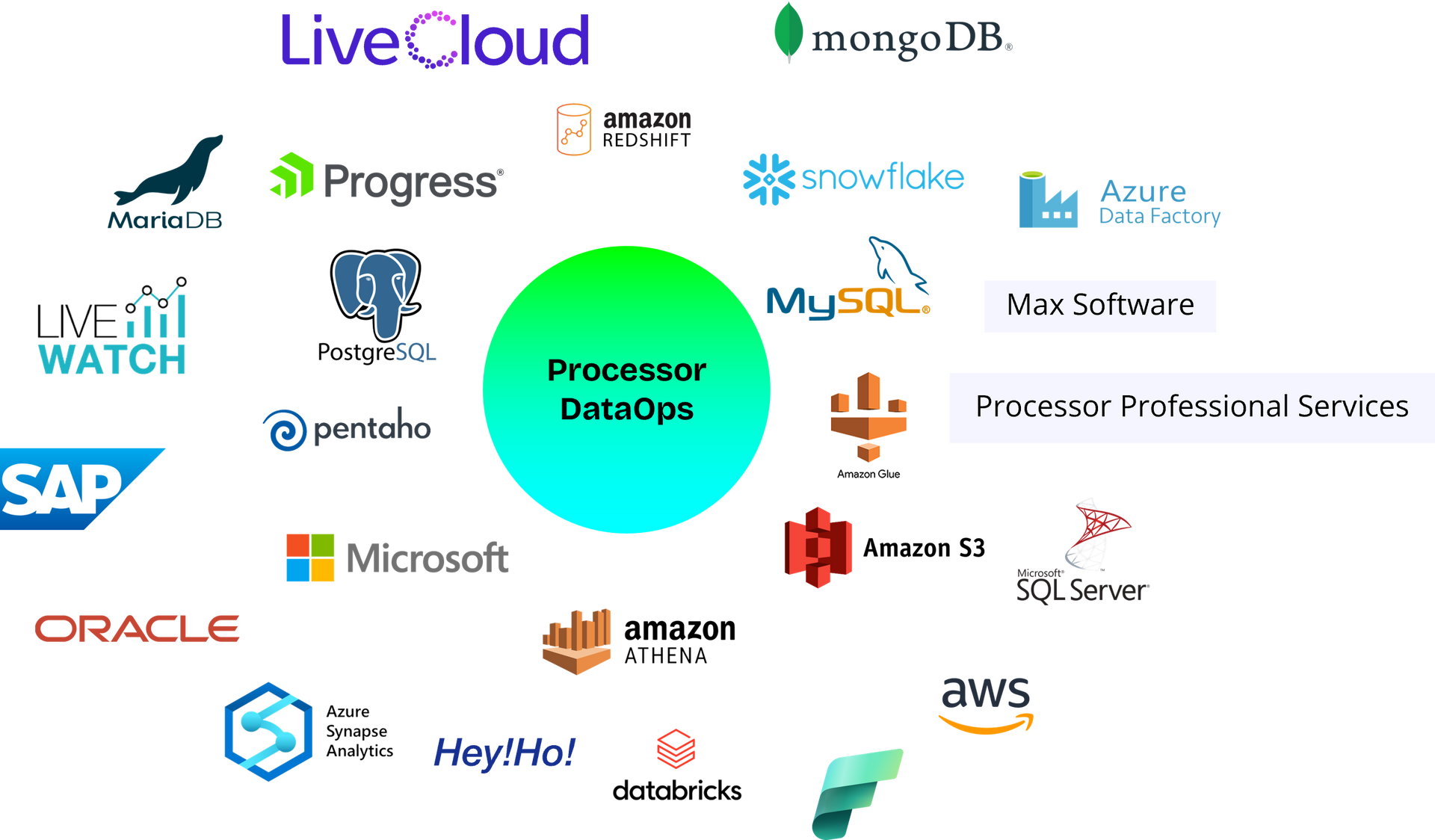
Main technologies used in DataOps

Decision
Application and use of advanced AI techniques for data analysis, such as data mining, clustering, predictive and prescriptive analytics, with the aim of identifying patterns, trends and anomalies, among others.
Sharing
Consistent access control and privacy policies for more secure data transfer between entities, enabling efficient collaboration and operational compliance inside and outside the organization.

Optimization
Automation of data collection, cleansing and analysis with version management, combining internal/external sources and connectors for agile operations and more accurate traceability over time.
Improvement
Implementation of data normalization, correction and enrichment to be processed through scalable routines.
Structuring
Design of intuitive dashboards for evidence-based insights and decisions, using more secure and efficient storage—on-premises, in the cloud, or hybrid—to drive business strategies.
Setup
Assessment of the environment and trends, with the definition of standards, procedures and tools for effective management based on a scalable architecture.


Raw data
Data Driven Company
Data journey in practice




Data & AI Insights
Want to learn more?
Fill out the form and our team of experts will contact you:


